
ChatGPT Ads Management
SignalTo lets businesses manage ChatGPT Ads using natural language. Connect your OpenAI advertising account, then use the SignalTo chat to create and manage campaigns, analyse performance, track conversions and make changes. SignalTo also connects paid advertising with the buyer questions it already measures through AI Visibility.
ChatGPT advertising is different from search advertising. There isn't a keyword box sitting between the customer and the advertiser. Someone might already be asking ChatGPT a buying question, comparing options or trying to solve a problem. That conversation is part of the context. Underneath the answer, there may now be an ad.
Ads buy the card. AI Visibility influences the answer.
OpenAI says ads do not influence ChatGPT's answers. The advertising system and the answer are separate, and advertisers cannot pay to shape, rank or alter the response.
So paying for a ChatGPT ad does not make ChatGPT recommend your business. It buys the sponsored placement below the answer.
Imagine someone asks ChatGPT a buying question in your market. ChatGPT answers and names your competitor. Your ad then appears underneath it.
You've paid to advertise below a recommendation for somebody else.
Earned visibility. Paid visibility.
SignalTo approaches the two separately.
One is earned visibility. The other is paid visibility. SignalTo gives you a way to work on both.
is about understanding where your business appears in AI answers, where competitors appear instead, and what you can change to improve your position.
is the paid side. It lets you advertise within relevant ChatGPT conversations.
SEO drives traffic. GEO influences answers. ChatGPT ads buy the card under the answer. They don't change the answer.
Independent research reinforces the distinction. In a 2026 study of 50,006 commercial prompts, SE Ranking reported that the advertiser was not cited in the answer in 96.37% of the ChatGPT ad placements it observed. That is SE Ranking's dataset, not SignalTo's, but it illustrates why buying the ad and improving your place in the answer are different jobs.
Manage ChatGPT Ads by talking to SignalTo
Traditional ad platforms tend to give you another dashboard to learn. SignalTo takes a different approach.
Connect your ChatGPT Ads account using your OpenAI Ads API key and the SignalTo chat becomes the management interface.
You can ask questions in normal English:
- How did my ChatGPT ads perform this week?
- Which ads are generating leads?
- Show me the campaigns spending money without converting.
- Create a campaign for our accounting service.
- Pause that campaign.
- Increase the budget on the campaign that's working.
- What would you change?
SignalTo reads the connected account through the ChatGPT Ads API, explains what is happening and can perform supported advertising actions from the conversation.
The machinery is still there. You shouldn't have to operate it like machinery.
See what's happening
Ask SignalTo about campaigns, ad groups, ads, spend, impressions, clicks, conversions and performance. Instead of hunting through reports, ask the question you want answered.
Create and manage campaigns
Create campaigns and make changes through the conversation rather than building everything manually inside an advertising dashboard. SignalTo translates the request into supported actions through the ChatGPT Ads API.
Understand performance
A cheap click can still be a bad click. SignalTo helps you look past surface metrics and understand which ads and offers are producing the result you care about.
Connect advertising to AI Visibility
SignalTo already measures the buyer questions where your business appears in AI answers and where another business gets mentioned instead. Those questions can inform your ChatGPT Ads strategy.
You're not starting with a blank keyword list. You're starting with conversations your potential customers may already be having.
Build context hints from buyer questions
ChatGPT Ads uses context hints to help OpenAI understand when an ad may be relevant. OpenAI says context hints should describe what you offer, who it helps or when it may be useful. They inform relevance, but they are not exact-match keywords and do not guarantee delivery.
SignalTo already has another source for that information: your AI Visibility data.
If SignalTo finds an important buyer question where competitors appear and you don't, that question can help inform the context used for a relevant advertising campaign.
"Targeting feels more like writing a brief than building a keyword list."
Measure what happens afterwards
Clicks are not customers.
OpenAI supports conversion measurement through the OpenAI Pixel, the Conversions API, or both. SignalTo supports browser and server-side conversion tracking, with safeguards against counting the same conversion twice.
The point is not simply to know that someone clicked. It's to work out which conversations, ads and offers are producing useful business outcomes.
Human approval stays in the loop
Natural language shouldn't mean uncontrolled spending. Campaigns created through SignalTo default to off. Spend requires explicit human approval.
ChatGPT Ads targeting starts with the conversation
Google Ads taught marketers to think in keywords. ChatGPT Ads asks you to think about situations.
What is the person trying to work out? What have they already told ChatGPT? What decision are they making? Where does your business genuinely help?
OpenAI says its ad system considers signals including the context and intent of the current conversation, the ad's landing page and copy, advertiser-provided context hints and targeting selections.
That is why the connection to AI Visibility matters. SignalTo is already looking for the questions people ask when choosing businesses like yours. Those questions can help inform the paid campaign too.
We spent A$640 learning how ChatGPT Ads behave
Before building ChatGPT Ads management into SignalTo, I wanted some real data. So I advertised SignalTo.
Between 15 and 28 September 2026, I spent about A$640 across a pilot, a campaign offering our free AI Visibility Report and a campaign aimed at agencies.
The data is from one advertiser over a short period. It is unaudited, and seven leads is nowhere near enough to declare universal rules.
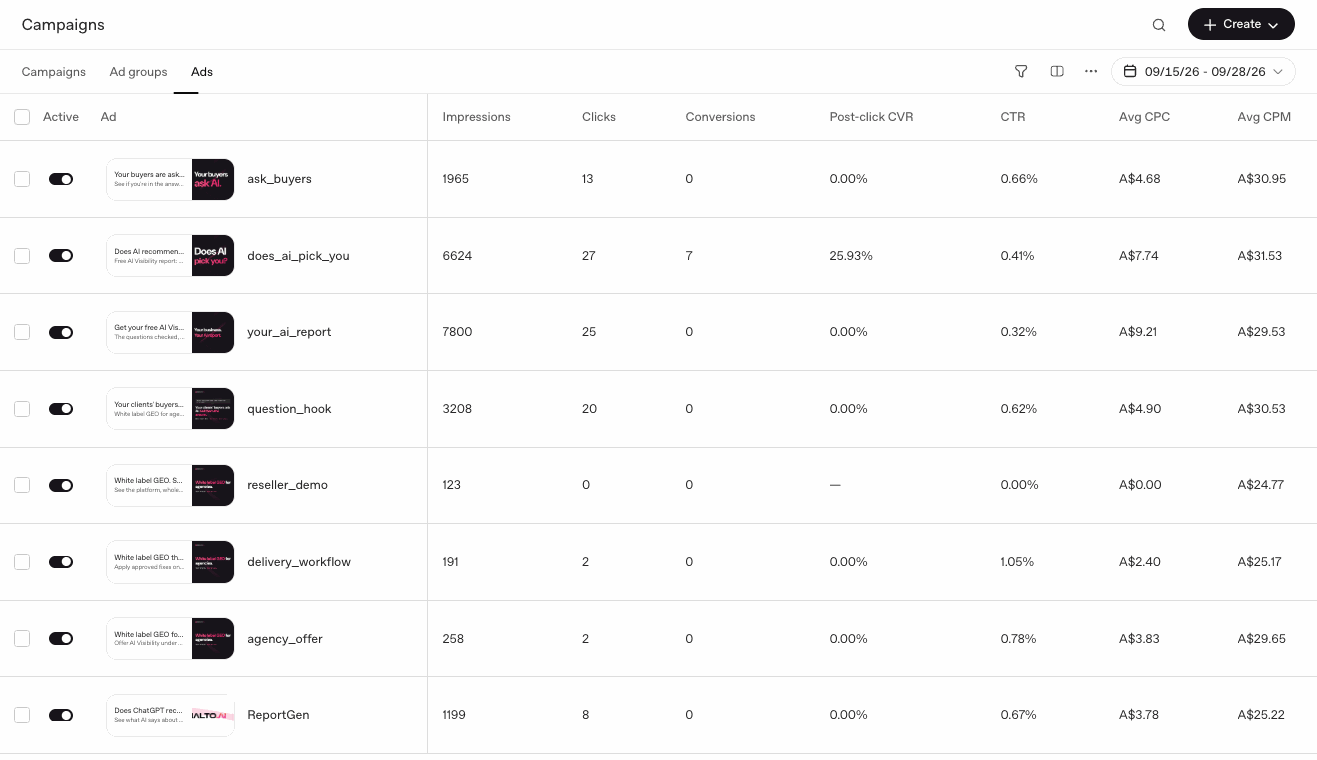
The main report campaign spent about A$500, delivered 16,389 impressions, generated 65 clicks and produced 7 leads.
All seven leads came from one ad. That ad opened with a question.
Another ad led with the free report offer. It received more impressions and produced no leads. The third generated the highest CTR and cheapest clicks of the three. It also produced no leads.
Across the main campaign, the blended cost per lead was about A$71. The question-led ad produced its seven leads at about A$30 each. Both numbers matter.
The agency campaign spent about A$114, generated about 3,780 impressions and 24 clicks, but no demo bookings.
My read was simple: Real interest paired with the wrong ask for a first touch.
Read what I learned spending A$640 on ChatGPT ads for the full test, including the ads that failed.
The test was independently covered by Industry Contents.
Three things stood out
1. A question beat the offer
The ad that produced every lead opened with a question. The person isn't scrolling a social feed. They're already having a conversation. A question can continue that line of thought rather than interrupting it with an offer.
But I wouldn't turn seven leads into a law of advertising. Our earlier pilot also used a question-led opening and produced no report requests.
It is a direction worth testing. Not a benchmark.
2. Delivery picks a winner quickly
In the agency campaign, one ad received about 85% of the campaign's impressions within three days.
SE Ranking saw similar concentration in a much larger test. Its 48 ads generated 97,131 impressions, but delivery was heavily concentrated in a small number of ad groups and creatives.
Putting several variants into the same campaign does not mean they will receive equal exposure.
3. CTR can tell you almost nothing about the business result
Our ask_buyers ad had the highest CTR and cheapest clicks of the three report ads. It produced no leads.
Our converting ad had a lower CTR, but generated all seven leads.
SE Ranking's larger test produced 97,131 impressions, 1,263 clicks and a 1.30% CTR, but almost no sign-ups.
Different campaigns. Different businesses. Different dates. But the same warning:
Don't judge ChatGPT Ads on CTR alone. Judge them on what happens after the click.
How do ChatGPT Ads work?
ChatGPT Ads are clearly labelled sponsored placements that can appear below a ChatGPT answer.
OpenAI says ads are selected using expected relevance and outcomes. Signals can include the current conversation's context and intent, the landing page, the ad itself, advertiser-provided context hints and supported targeting selections.
Context hints are not exact-match keywords. They are additional information that helps OpenAI understand when the advertiser may be relevant.
OpenAI currently supports campaign objectives around reach, clicks and conversions. Buying and optimisation options can change as the beta develops, so current OpenAI Ads Manager documentation should be treated as authoritative.
You cannot pay to change ChatGPT's answer.
How much do ChatGPT Ads cost?
There isn't a useful universal benchmark yet.
| Metric | SignalTo test |
|---|---|
| CPM | About A$25 to A$32 |
| CPC | About A$4.70 to A$9.20 |
| Main campaign CTR | 0.40% |
| Main campaign leads | 7 |
| Blended cost per lead | About A$71 |
| Converting ad cost per lead | About A$30 |
These are not industry benchmarks. They are one advertiser, one product, a small amount of money and roughly two weeks of testing.
The A$30 figure should not be separated from the A$71 blended figure. Two other report ads spent about A$290 between them and produced no leads.
ChatGPT Ads in Australia
Self-service ChatGPT Ads Manager is available to Australian advertisers at the time of writing. OpenAI still describes Ads Manager as beta, so features, delivery, inventory and performance can change.
These campaigns weren't only about acquiring customers for SignalTo. I ran them to understand the platform before SignalTo customers start running their own.
I'd rather learn with our money first.
ChatGPT Ads for agencies
AI is beginning to create an organic and paid split.
The organic question is: What does AI say about the client, and who does it recommend?
The paid question is: Where should the client advertise inside those conversations?
They are different jobs, but the intelligence overlaps. The buyer questions SignalTo discovers while measuring AI Visibility can help inform the conversations an advertiser may want to reach through ChatGPT Ads.
See White Label GEO for SignalTo's existing agency proposition.
Common questions.
What is ChatGPT Ads management?
ChatGPT Ads management is the creation, monitoring and optimisation of advertising campaigns that appear inside ChatGPT. SignalTo lets you manage a connected ChatGPT Ads account through a natural-language chat interface.
How do ChatGPT Ads work?
Ads can appear as clearly labelled sponsored placements below ChatGPT answers. OpenAI selects eligible ads using signals including conversation context and intent, the ad and landing page, context hints and supported targeting selections.
How much do ChatGPT Ads cost in Australia?
There is no established Australian benchmark. In SignalTo's September 2026 test, CPM was roughly A$25 to A$32 and CPC ranged from about A$4.70 to A$9.20. That is first-party data from one advertiser.
Can advertisers pay to be recommended by ChatGPT?
No. OpenAI states that ads do not influence ChatGPT's answers.
Do question headlines work better than offers?
They did in SignalTo's main September 2026 test, but an earlier question-led pilot generated no report requests. The evidence is directional, not conclusive.
Can SignalTo spend my advertising budget without approval?
No. Campaigns created through SignalTo default to off and spend requires explicit approval.
Who sees ChatGPT Ads?
OpenAI currently says ads may appear to people using ChatGPT's Free and Go plans. Plus, Pro, Business, Enterprise and Edu accounts do not see ads, and ads are not shown to accounts identified as belonging to people under 18.
Do I need AI Visibility Management if I run ChatGPT Ads?
No. Paid and organic visibility are separate. Understanding the questions where AI already mentions your business or competitors can still help decide which conversations may be worth advertising around.
Know the answer before you buy the ad
You don't have to advertise in ChatGPT. And you don't have to wait for perfect organic AI Visibility before testing paid. They're two separate systems.
But it makes sense to know what the answer says before paying to put your business underneath it.
Run the free AI Visibility Report and see which buyer questions already mention you, which mention somebody else, and where you don't appear at all.
Then decide. Improve the answer. Advertise into the conversation. Or do both.
Plans are on the pricing page. Questions? Contact Roo.