
Industry Contents independently covered this test in How ChatGPT Ads Work.
This is the fuller version.
I ran the campaigns, spent the money and had access to the ad-level results.
The figures below come from our ChatGPT Ads dashboard and are unaudited.
Seven leads is enough to show me a direction.
It isn’t enough to declare a rule.
TL;DR
- I spent about A$640 across three ChatGPT Ads tests.
- The main campaign produced 7 leads from 65 clicks, and every lead came from one question-led ad.
- The ad with the most impressions produced zero leads.
- CPM stayed at roughly A$25 to A$32, while CPC ranged from about A$4.70 to A$9.20.
- The bigger lesson wasn’t CTR. It was what happened after the click.
Why I ran the test
SignalTo measures how businesses appear in AI answers.
We were also building ChatGPT Ads management into the platform, so I wanted to understand the advertising side with our own money before customers started spending theirs.
I wasn’t trying to create a definitive ChatGPT Ads benchmark.
I wanted answers to practical questions.
How does delivery behave?
What does targeting feel like?
What gets clicked?
What gets ignored?
And, most importantly, what turns into a lead?
These campaigns weren’t only about acquiring customers for me. I ran them to learn what works on the platform before our customers start running their own.
The setup
I tested two offers.
The first was SignalTo’s free AI Visibility Report for business owners.
The second was a white-label GEO demo aimed at agencies.
There was also an earlier pilot.
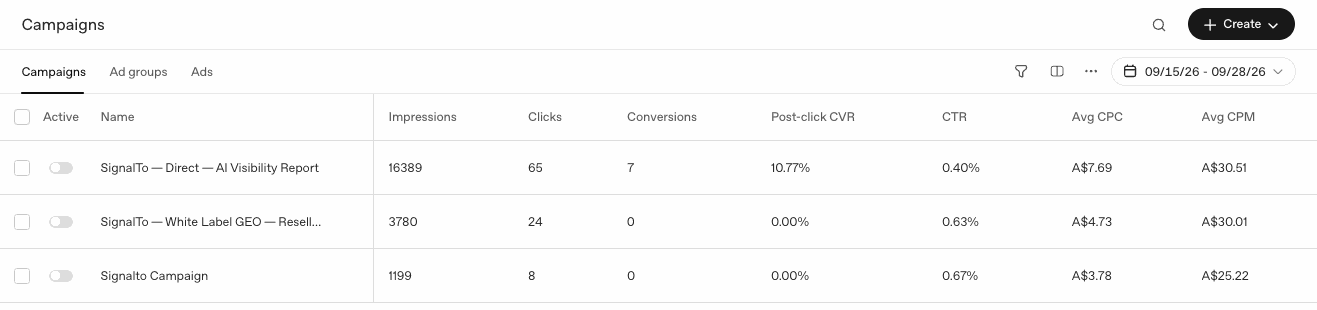
The pilot ran under a different billing model and at a different time, so I don’t treat it as directly comparable with the main campaigns. It delivered 1,199 impressions, 8 clicks, a 0.67% CTR, an average CPC of A$3.78, and zero report requests.
The main campaigns were billed per impression.
Targeting also felt different from paid search.
My simplest description is still:
“Targeting feels more like writing a brief than building a keyword list.”
ChatGPT Ads uses the context of the conversation plus information supplied by the advertiser, including context hints, to decide where an ad may be relevant.
That makes the question the person is asking unusually important.
The report campaign
The business-owner campaign offered a free AI Visibility Report.
| Metric | Result |
|---|---|
| Spend | About A$500 |
| Impressions | 16,389 |
| Clicks | 65 |
| CTR | 0.40% |
| Average CPC | A$7.69 |
| CPM | A$30.51 |
| Leads | 7 |
| Click-to-lead rate | 10.8% |
| Blended cost per lead | About A$71 |
The campaign total hides the interesting part.
| Ad | Opening | Impressions | Clicks | Leads | CTR | Avg CPC |
|---|---|---|---|---|---|---|
| does_ai_pick_you | Question | 6,624 | 27 | 7 | 0.41% | A$7.74 |
| your_ai_report | Free report | 7,800 | 25 | 0 | 0.32% | A$9.21 |
| ask_buyers | Buyer question | 1,965 | 13 | 0 | 0.66% | A$4.68 |
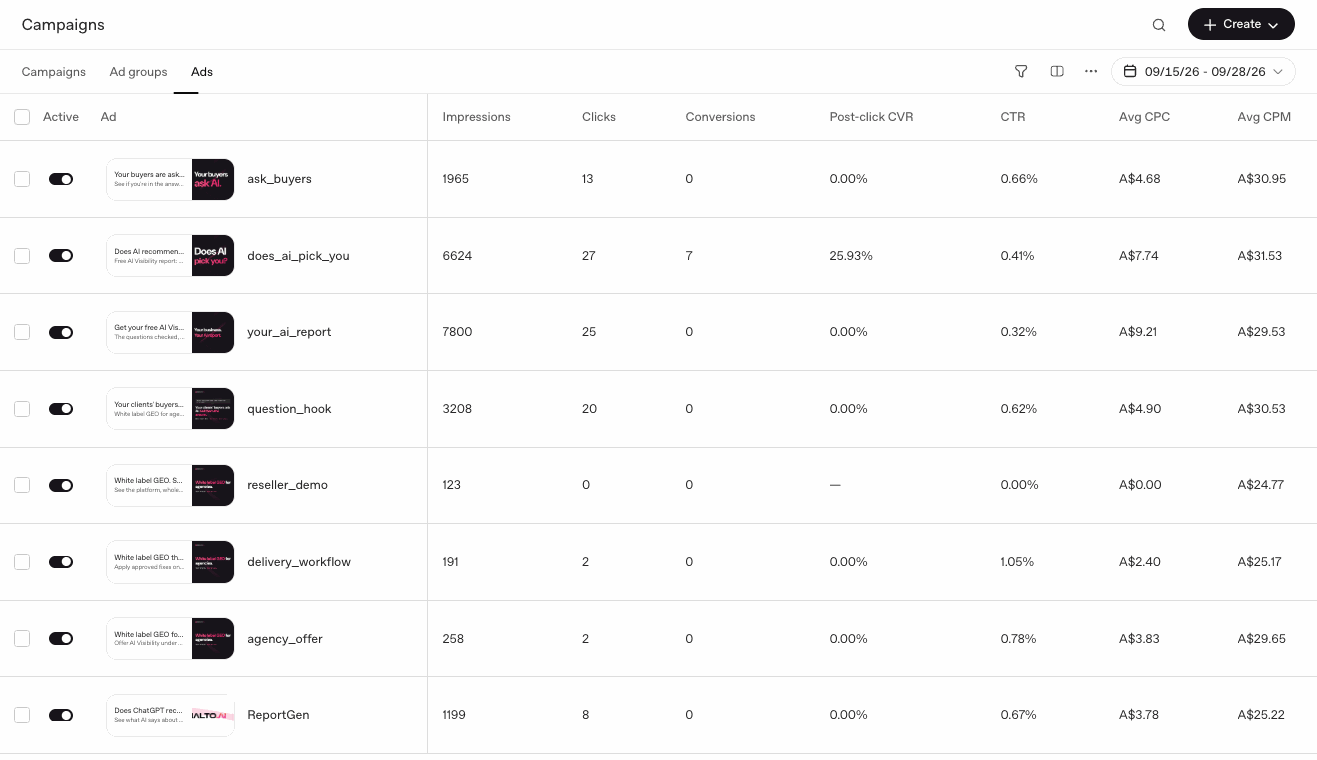
Every lead came from does_ai_pick_you.
Seven leads from 27 clicks is about a 26% click-to-lead rate, with a cost per lead of about A$30 for that ad.
But I don’t think the A$30 number should ever be quoted on its own.
Across the whole campaign, I spent about A$500 to get seven leads. That is about A$71 per lead blended.
The other two ads spent about A$290 between them and produced nothing.
That is the number I’d use if I were deciding whether the campaign worked commercially.
The ad with the cheapest clicks produced no leads
ask_buyers had the highest CTR at 0.66% and the cheapest average CPC at A$4.68.
It generated zero leads.
does_ai_pick_you had a lower CTR of 0.41% and a higher average CPC of A$7.74.
It generated all seven.
That was probably the most useful lesson in the test.
CTR tells me that someone was interested enough to click.
It doesn’t tell me whether the ad, landing page and offer made sense together.
A cheaper click isn’t automatically a better click.
Why I think the question worked
The converting ad opened with a question.
My working theory is that this fits the environment.
The person is already mid-conversation with an AI. They’re thinking through something, comparing something or trying to make a decision.
A question can continue that line of thought.
An offer can feel like an interruption.
So my current view is:
A question works better than an offer.
But I need to put a large asterisk beside that sentence.
The earlier pilot also opened with a question and produced zero report requests.
Seven conversions is enough to show a direction, not enough to draw firm conclusions.
The next test should isolate the variable properly: same audience, same landing page, same campaign conditions, question headline against a plain offer.
The agency campaign
The second main campaign targeted agencies with a white-label GEO demo offer.
| Metric | Result |
|---|---|
| Spend | About A$114 |
| Impressions | About 3,780 |
| Clicks | 24 |
| CTR | 0.63% |
| Average CPC | A$4.73 |
| CPM | A$30.01 |
| Demo bookings | 0 |
On the surface, the campaign wasn’t terrible.
A 0.63% CTR was better than the report campaign’s 0.40%.
The average CPC was cheaper too.
But nobody booked a demo.
So commercially, it didn’t work.
My read is:
Real interest paired with the wrong ask for a first touch.
Someone clicking an ad about a new category is not necessarily ready to book time with me.
A sample report or something they can inspect themselves is probably a better next test than asking for a meeting.
Delivery picks a winner fast
The agency campaign also showed me something about creative testing.
One ad, question_hook, took 3,208 of about 3,780 impressions within three days.
That’s roughly 85% of the campaign’s delivery.
If the platform makes that decision quickly, putting six variants into one ad group does not necessarily give you six meaningful tests.
Some may barely get shown.
That isn’t unique to our test.
SE Ranking ran a much larger ChatGPT Ads experiment with 97,131 impressions, 1,263 clicks, eight ad groups and 48 ads. It also reported heavily concentrated delivery, with a small number of groups and creatives taking a disproportionate share of impressions.
So one thing I would change next time is the test design.
If I really need a fair comparison between two messages, I would consider separating them into campaigns or otherwise structuring the test so one variant cannot starve the other before I learn anything.
SE Ranking got more clicks. It still struggled to convert them.
SE Ranking’s test is useful because it is much larger than mine.
It generated 97,131 impressions and 1,263 clicks, with a reported 1.30% CTR.
But it reported almost no sign-ups and stopped the test early.
SignalTo is B2B software too, but my result was different.
The report campaign produced seven leads from 65 clicks.
That doesn’t prove ChatGPT Ads works for B2B SaaS. SE Ranking’s result doesn’t prove it doesn’t.
What the two tests suggest to me is that getting the click isn’t necessarily the difficult bit.
Matching the conversation, the message and the next ask probably is.
SE Ranking generated plenty of clicks without sign-ups.
My agency campaign produced clicks without demo bookings.
My cheapest-click report ad produced clicks without leads.
The only meaningful conversion in my test came when one particular question-led ad led into a low-friction free report.
That is the part I want to understand better.
CTR is not the metric I would optimise first
If I had judged the report campaign by CTR, I might have backed the wrong ad.
If I had judged the agency campaign by clicks, I might have convinced myself it was working.
SE Ranking’s larger test makes the same problem harder to ignore.
So for the next test I care about:
- Qualified leads per dollar.
- Which ad and conversation produced them.
- Whether those leads open the report, reply, book a call or become customers.
CTR still matters diagnostically.
It tells me something about the ad.
It does not tell me whether I have a business result.
What did ChatGPT Ads cost me?
Across the pilot, report campaign and agency campaign, I spent about A$640.
One thing was surprisingly consistent.
Pricing felt like flat CPM.
Across the ads and audiences, CPM sat at roughly A$25 to A$32 per thousand impressions.
CPC moved much more, from about A$4.70 to A$9.20.
That gap came from the creative and resulting click rate, not from a wildly different price for the impressions.
Here is the small benchmark table I would keep from this test:
| Metric | Observed range/result |
|---|---|
| CPM | About A$25 to A$32 |
| CPC | About A$4.70 to A$9.20 |
| Report campaign CTR | 0.40% |
| Agency campaign CTR | 0.63% |
| Report campaign click-to-lead | 10.8% |
| Report campaign blended CPL | About A$71 |
| Converting ad CPL | About A$30 |
This is n=1.
One advertiser. One product. A small budget. Roughly two weeks. Unaudited dashboard data.
I would not use these numbers as a market benchmark.
I would use them as a starting point for another test.
How I would run the next test
I wouldn’t simply add more ads and spend more money.
I’d make the test cleaner.
- I would test a question headline against a plain offer while keeping the rest of the setup as close as possible.
- If delivery starts starving one variant, I would separate the tests rather than pretend both received a fair run.
- I would send conversions through the OpenAI Pixel or Conversions API and reconcile them against our own form and customer records.
- I would judge the campaign on qualified leads per dollar, not CTR.
- I would follow every lead through to the eventual customer result.
The agency test needs a different next step too.
I would test something lower friction than a demo booking. A useful sample report makes more sense to me because the person can see the problem before deciding whether they want a conversation.
What I’m building into SignalTo from this
The point of spending our own money was to feed the learning back into the product.
SignalTo now connects ChatGPT Ads management with something it already knows: the buyer questions where a business appears in AI answers and where competitors appear instead.
That matters because ChatGPT Ads targeting is not simply a keyword exercise.
OpenAI uses the conversation’s context and intent alongside the ad, landing page, targeting selections and advertiser-provided context hints.
SignalTo already has a set of real buyer questions from its AI Visibility work.
Those questions can help inform where paid advertising might make sense.
The other lesson is around testing.
If delivery picks a winner quickly, the system needs to make that visible rather than letting someone assume every creative received a fair test.
And if a high CTR produces no leads, the product needs to keep the conversation focused on outcomes rather than congratulating the advertiser for cheap clicks.
You can read more about the product side on ChatGPT Ads Management.
Paid and organic are separate
There is another reason this experiment matters to SignalTo.
OpenAI says advertisers cannot pay to influence ChatGPT’s answer.
The ad sits below the answer. It does not buy a place inside it.
So a business can pay for the sponsored card while a competitor is still being recommended above it.
That is why I don’t see ChatGPT Ads and AI Visibility as substitutes.
They solve different problems.
The organic question is: Does AI mention or recommend you?
The paid question is: Should you advertise inside that conversation?
SignalTo works across both.
What happens next
The honest answer is that seven leads is too early to tell me what the customer economics look like.
The next useful number isn’t another click.
It is what those leads do next.
Do they open the report?
Do they reply?
Do they book a conversation?
Do they become paying customers?
I will update this article as there is enough data to say something useful.
Update log
1 October 2026: Initial publication. Lead-to-customer outcomes are still too early to report.
Methodology
The test data in this article comes from SignalTo’s ChatGPT Ads dashboard for 15 to 28 September 2026.
The figures are unaudited.
Campaign totals and averages are reported as displayed in the dashboard, with approximate values identified as approximate.
The pilot ran before the main campaigns and used a different billing model, so I have not treated it as directly comparable.
The report campaign and agency campaign were billed per impression.
Industry Contents independently reported on the experiment on 30 September 2026. Its article is linked at the top of this page.
I have also compared my observations with SE Ranking’s separate, much larger ChatGPT Ads test. Their campaign, product, dates and setup were different, so I use it as comparative evidence rather than merging their numbers with mine.
FAQ
Do ChatGPT Ads work for B2B?
My SignalTo test produced seven B2B leads, all from one ad. SE Ranking’s much larger B2B SaaS test generated 1,263 clicks but almost no sign-ups. I think that is evidence to test the offer and next step carefully, not evidence for a universal yes or no.
What CTR should I expect from ChatGPT Ads?
I don’t think there is a reliable benchmark yet. My main report campaign had a 0.40% CTR and the agency campaign had 0.63%. SE Ranking reported 1.30% in a much larger test, but almost no sign-ups. CTR without the conversion result can be misleading.
How much did ChatGPT Ads cost per lead?
The main SignalTo report campaign produced seven leads at about A$71 each blended. The single ad that generated all seven was about A$30 per lead, but quoting that figure alone would ignore the spend on the two ads that generated no leads.
Should I pay per click or per impression?
I don’t have enough data to claim one model is universally better. The pilot and main campaigns also ran at different times, so I would not use my test as a clean comparison between the two billing models. Use the current options available in OpenAI Ads Manager and judge them against your campaign objective and conversion data.
Do question headlines beat offers in ChatGPT Ads?
A question-led ad generated every lead in my main campaign, while the free-report-led ad generated none. But my earlier pilot also used a question-led opening and generated no report requests. I think questions are worth testing in a conversational environment, but I do not think my sample proves they always win.
Next step
Before paying to sit underneath an AI answer, it helps to know what that answer already says about you.
Run a free AI Visibility Report to see which buyer questions mention your business, which mention competitors instead, and where you are missing.
Then decide whether to improve the organic answer, advertise into the conversation, or do both.